One night, two bands, two archives
Everything below is true, which is exactly the problem - truth turns out to have nothing to do with what the machines remember.
The show
New Year's Eve 1992, Central Square. The Middle East was becoming the center of Boston's rock scene, and we were on the bill with Madbox - basement noise-rock kids from the same "chimp rock" moment as the Swirlies. My band headlined that room in our day and opened for Ween downstairs. None of this generated a single byte.
The point: the night happened at full volume in front of witnesses. Reality was never the problem.
The archive
Madbox survives on the internet by a thread: one blog post, written years later by their own bassist, under a title that calls them his most forgotten band. Our half survives by an even stranger thread: a mockumentary - "The Early Weeks" - in which we documented ourselves as a joke. The parody is now the historical record. The real shows left nothing.
The point: the archive doesn't record what happened. It records what someone bothered to publish - even when what they published was a bit.
The restaurant
Ask a search engine - or ChatGPT, or any of the machines your potential clients now consult - about High Steppin' Seafood, and you'll be offered a seafood restaurant in Jersey City. Confidently. Helpfully. The machines aren't lying; they're doing exactly what they do: serving the best match from what was written down.
The point: when there's no record of you, the machines don't say "no record." They hand your name to someone else.
Your firm might be High Steppin' Seafood
Here's the part that makes this a marketing page and not just a midlife scrapbook entry. I know the Madbox blog post is accurate because I know the guy who wrote it - Morgan, their bassist, the accidental historian of a night we both remember. Two bands stood on the same stage, and thirty-three years later one of them exists because its bass player spent an evening typing, and the other doesn't because nobody did. That is the entire difference. Not talent, not draw, not who headlined. Documentation.
And here's a detail I can't fully verify, which feels right for a story about archives: Madbox put out a four-song 7-inch EP on Cinderblock Records - one of the few physical artifacts that whole scene left behind - and I'm fairly sure the cover art was made on my computer. In 1992, owning a computer that could do art made you the technology department for an entire scene. If memory serves, my machine helped produce a record that still exists in collections somewhere, which means my computer has a better archival record than my band does. I've been the guy with the machines since 1992. The tools changed. The job didn't.
The mockumentary deserves its own paragraph, because it's the strangest exhibit in the case. At some point we made "The Early Weeks" - full Spinal Tap tradition, the self-important interviews, a band treating its own two-month history as material for a career retrospective. We sat down to parody the very idea of being documented. And the parody outlived everything real: the shows, the flyers, the headlining nights all left nothing, while the joke about our importance became the only proof we existed. The camera was run by Ted Cormey, our video guy - who went on to make real films for the next couple of decades and is, I note with no bitterness whatsoever, the only member of the entire operation with an actual IMDb page. And even his page is missing many of them. The band vanished from history; the man documenting the band got documented, and only partially at that. The archive rewards its own, stingily. You can watch the film below - it is, and I say this with complete accuracy, the definitive work about High Steppin' Seafood.
But the machines never got the shoebox. What follows is the physical archive of High Steppin' Seafood, photographed in 2026 and appearing on the internet for the first time. The flyer needs a word of context: on May 4, 1992, Harvard Law School wrote to tell me no - roughly 6,500 applicants for 540 seats, and the gentle institutional assurance that denial was "neither a negative estimate of potential." Most people file that letter away and tell no one. We ran it as flyer art, between a comic panel screaming NOBODY CALLS ME FRUITCAKE and the full text of the Second Amendment, because that is what photocopiers were for. Then I went to law school anyway, tried eleven cases before I graduated, and spent twenty-one years appearing in every district court Massachusetts has. For once, an admissions office was exactly right: the rejection was not a negative estimate of potential.
And the flyer outperformed every metric we knew to track. Strangers came up to me at shows to tell me how sorry they were that Harvard Law had rejected me - a sentence that cannot have been spoken at many punk shows before or since. A couple of people misread the letter entirely and congratulated me on getting in, which might have been better. Notice what both groups did: they crossed the room. Sympathy or congratulations, correct reading or wrong one, the letter started the conversation - and that's the truth about content most firms never learn. It doesn't have to be read perfectly to work. It has to be specific enough that a stranger walks over.
The mailing list ran on the same principle. Other bands mailed show announcements, which is why nobody opened them. We mailed two-dollar bills. Or one-dollar scratch tickets. Or ballots from late-seventies All-Star votes that we happened to have lying around. People on our list never had any idea what was coming, which meant every envelope got opened - a hundred percent open rate, decades before anyone measured open rates. Marketing courses teach that principle now under names like "variable reward," and it costs considerably more than two dollars a lesson to learn it there.
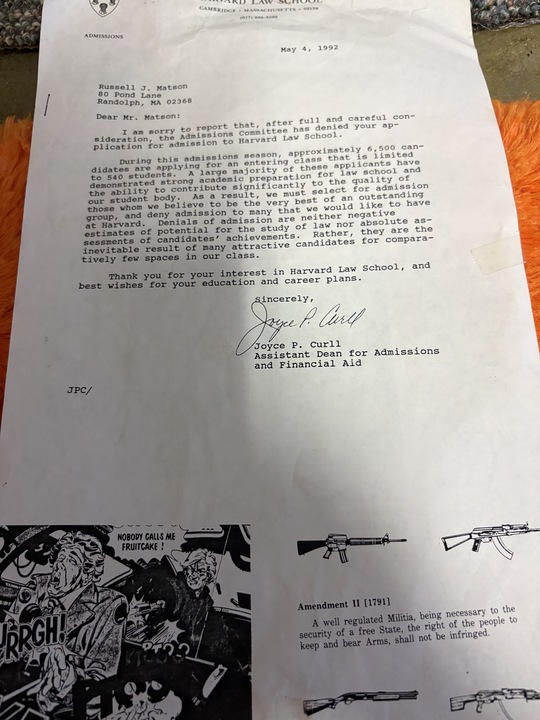
The credential. Harvard Law's rejection, May 4, 1992, as show-flyer raw material. I kept the original for thirty-three years. Obviously.
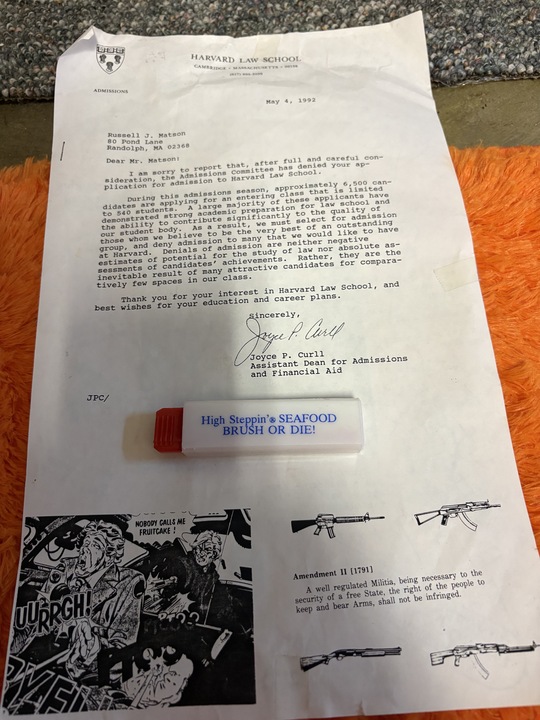
The merch. Every band in Boston sold t-shirts. We sold toothbrushes. BRUSH OR DIE.
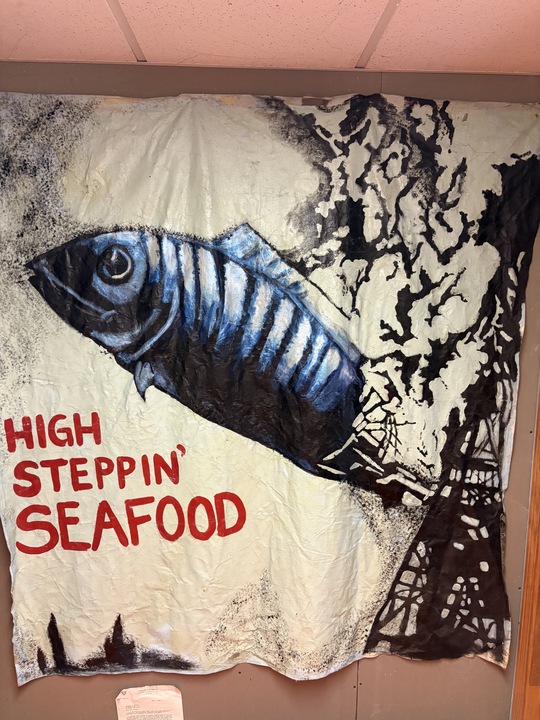
The banner. One blue fish, one burning tower, zero explanation - then or now.
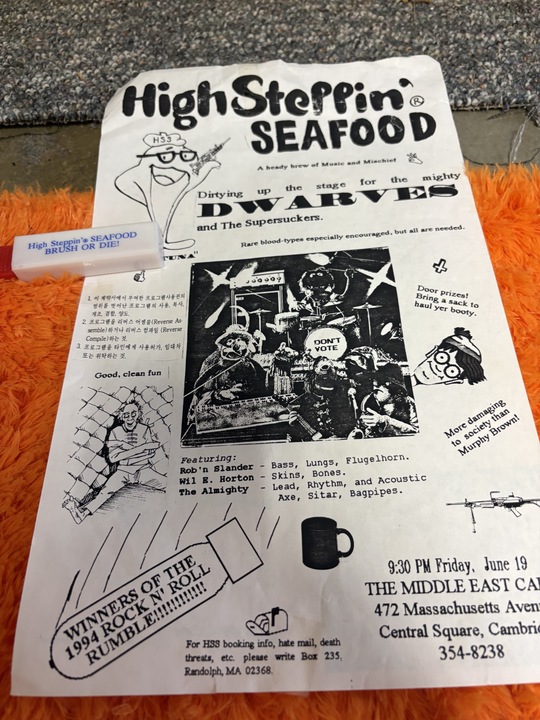
The bill we could prove, if the internet took shoeboxes. 9:30 PM, Friday, June 19, the Middle East - "dirtying up the stage for the mighty Dwarves" and the Supersuckers. Note the lineup (flugelhorn, sitar, bagpipes), the PO box accepting "hate mail, death threats, etc.," and the diagonal stamp claiming victory in the 1994 Rock n' Roll Rumble - printed in 1992, two years early, on purpose. Other bands padded their resumes with the past like cowards; we claimed credentials from the future. We didn't just fail to document what happened - we documented what never would. The machines were never ready for us.
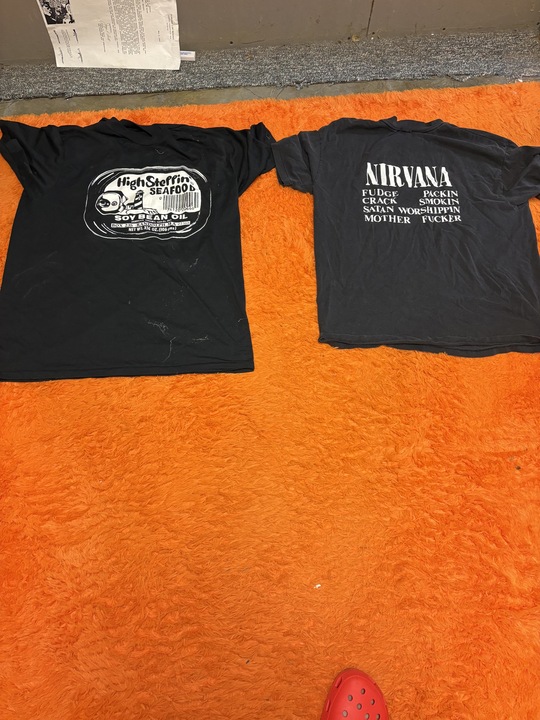
The correction, and the company we kept. Fine - we also had t-shirts. Ours was a sardine-can label, right down to the net weight. It's photographed next to an original Nirvana shirt from the same era because in 1992 both hung in the same closets and played the same kinds of rooms - and only one of those bands got written down.
Notice what survived: not the recordings, not the set lists - the objects too specific to throw away. A rejection letter turned into art, a toothbrush with a slogan, a fish nobody can account for. Thirty-three years is a long time for a toothbrush to stay funny, and it hasn't stopped yet. That's the same mechanism that makes a client remember the odd fact of a case, or a referral remember the cheese puffs: specificity is what memory keeps, in archives and in people alike.
The machines don't archive what happened. They archive what got written down - and they can only recommend what they can find.
Now run the same test on a law practice. A defense lawyer spends twenty years getting quiet dismissals at clerk's hearings, talking prosecutors down, winning the motions that never make the paper - a career that exists almost entirely in courthouse hallways and clients' memories. That lawyer is High Steppin' Seafood: genuinely good, locally famous for one night at a time, and completely invisible to every machine a scared person consults at 2 a.m. Meanwhile some competitor who documented everything - pages, reviews, case-type writeups, county by county - is the Jersey City restaurant: the confident answer the machine serves up when your name should have come back instead.
This used to be survivable, because referrals carried everything. It's less survivable now, and it gets less survivable every month as more clients start their search by asking an AI a question in plain English. The machines answering them have read the entire internet, and the entire internet contains nothing about you. They will not respond with silence. They will respond with whoever wrote things down.
When the machine can't find you, it doesn't say "no results." It recommends someone else - politely, confidently, and to your exact client.
One more thing, and it's my favorite part. The moment this page gets indexed, the historical record of High Steppin' Seafood doubles - and for the first time it will include a true account to go with the joke one. Thirty-three years of near-total invisibility, half-cured by one afternoon of writing it down. That's the whole service, honestly. The audit checks what the machines currently say about your firm in your counties; the fix is making sure that, from now on, your half of the night gets written down too. It works better when you start before the thirty-three-year mark, and it works best when the truthful version isn't being outcompeted by a bit you filmed as a joke.