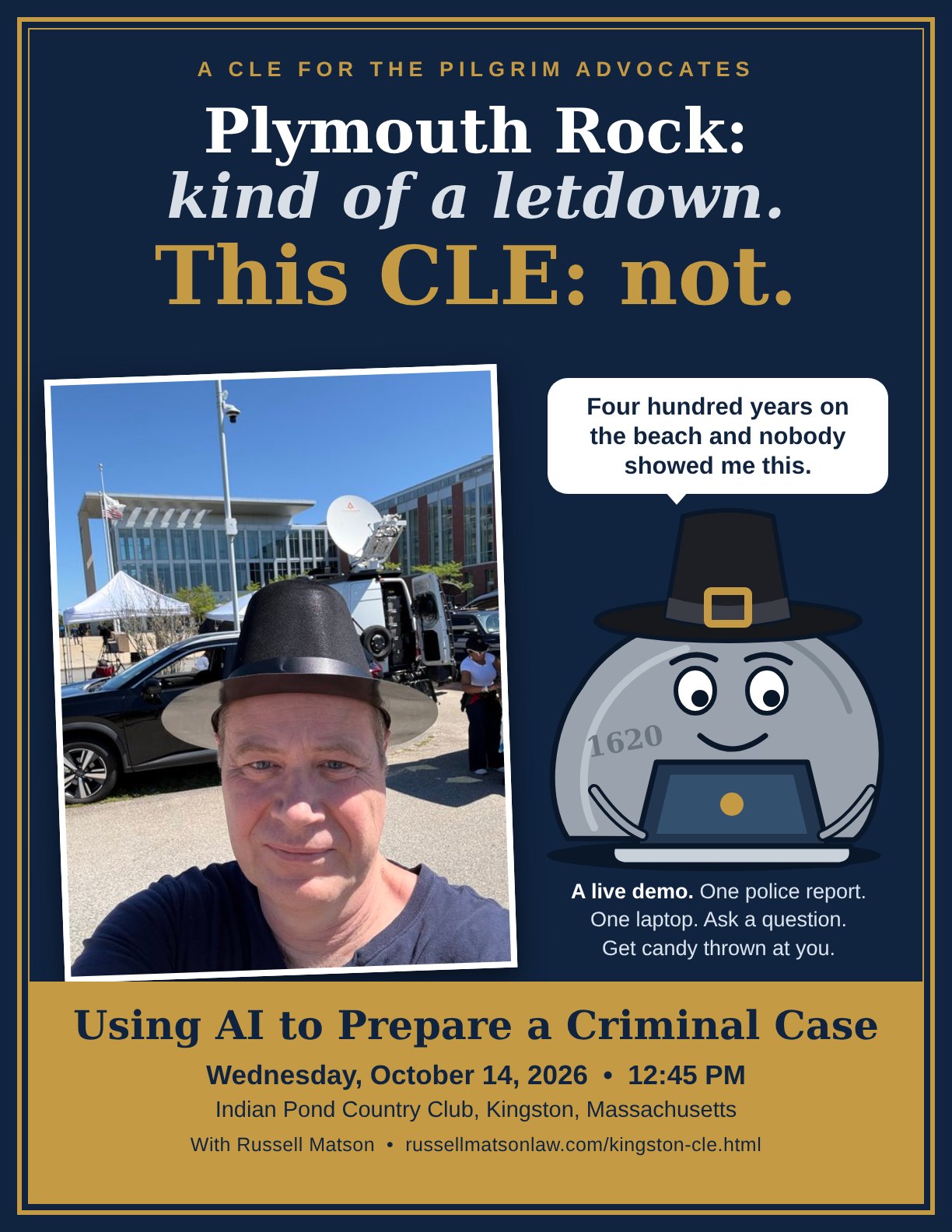
Using AI to Prepare a Criminal Case
A CLE for the Pilgrim Advocates, Plymouth County.
Wednesday, October 14, 2026, 12:45 PM. Indian Pond Country Club, Kingston, Massachusetts.
A live demo. One police report. One laptop. Ask a question and I will throw candy at you.
This page has the prompts and the sources from the talk, so you do not have to take notes.
The example: one OUI police report
We work from one published police report. It is a Somerville OUI from September 2021. A car hit a dumpster a little before 1 a.m. The first officer said the man by the driver's door told him he hit it. Later the man said a friend had been driving and had left.
The report lists unsteadiness, bloodshot eyes, an odor of alcohol, and a statement about drinking. It also lists refusals of field sobriety tests and a breath test.
That is all we have. One published story. No full discovery file. No verified outcome. These are allegations.
The first question for the room: what did each officer see himself, what came from someone else, and what is missing?
The first prompt
- Use only the supplied report. Build a chronology with a source reference for every entry.
- Separate the reporting officer's observations, statements attributed to others, and inferences.
- List missing information. Mark it "not provided." Do not invent facts or legal authority.
The missing-evidence worklist
Ask the AI what is not in the file. For example: dispatch audio, CAD entries, supplemental reports, recordings, photographs, and lawfully obtained medical information.
Each request needs three things: a factual question, a likely custodian, and a step to preserve or produce it. These are ideas to check. They are not a claim that the records exist.
Cross-examination prompts
- Where and when did the officer attend the police academy, and how can I obtain the field sobriety training manual used in the officer's training?
- Suggest seven possible areas for cross-examination and draft ten questions for each area. Include the investigation into the claim that a friend was driving, how reliable unsteadiness is as a sign of intoxication, and what an odor of alcohol on the breath actually establishes. Include the possible effects of the accident on concentration, focus, and the ability to answer questions. Ask whether the officer is a medical expert who can tell those effects from intoxication. Suggest other areas.
Openings and closings
- Draft three possible defense opening statements using the supplied case materials. Give each a different theme and tone. Flag factual assumptions and promises to verify before using any version.
- Draft three sample defense closing arguments using the supplied trial record. Address the strongest prosecution evidence. Use only admitted evidence and the applicable jury instructions. Flag gaps instead of inventing facts.
A police report is not a trial record. A closing drafted from a report alone is a practice exercise.
The scene visit still matters
AI can organize what to look at: sight lines and lighting, the road layout, where cameras might be, and photographs tied to specific lines in the report. Then a person has to go. Write down what has changed since the incident.
Client confidentiality: Rule 1.6
Rule 1.6 asks for reasonable safeguards, not zero risk. A phone call someone might overhear is different from a clear livestream to a million viewers.
Before you upload anything, check the AI service, the settings, and who has access. Work from a copy of the police report and remove names and other identifiers. Removing names is a start. Other details can still identify the client.
You cannot make the error rate zero
An LLM can miss something. So can an associate. A second reviewer reduces risk. It does not erase it.
My view: refusing AI altogether may become the bigger risk. Learn to use it, check it, and move forward.
Two AIs. Neither under oath.
Let a second AI cross-examine the first. Give it the source material and ask it to find errors. Then check both answers against the sources yourself. Two confident answers can still share one mistake.
Here is an audit prompt: Audit this draft against the supplied sources. Identify unsupported facts, incorrect quotations, missing qualifications, and conclusions the sources do not establish. Give a source reference for every proposed correction. Mark unresolved issues for human review.
The "$100-a-month employee"
My setup is four desktops, each with a job. Look at what you spend, and what you still do by hand. One or two AI desktops may do much of that routine work for far less than hiring an employee.
I assign the work. I check the result.
Before you use any of this
- Every fact back to its source.
- Every legal claim back to current authority.
- Client information only in an approved workflow.
Sources
- Massachusetts Rule of Professional Conduct 1.6: Confidentiality of Information
- Massachusetts Rule of Professional Conduct 1.1: Competence
- Massachusetts Rule of Criminal Procedure 14: Pretrial Discovery
- ABA Formal Opinion 512 (July 29, 2024)
- Massachusetts law about artificial intelligence
This page is teaching material, not legal advice. Check the current rules yourself.
Want this talk for your group?
I teach this as a CLE for bar advocate programs and defense groups.